James Webb Telescope Discovers Most Distant Galaxy Yet, Challenging Early Universe Models
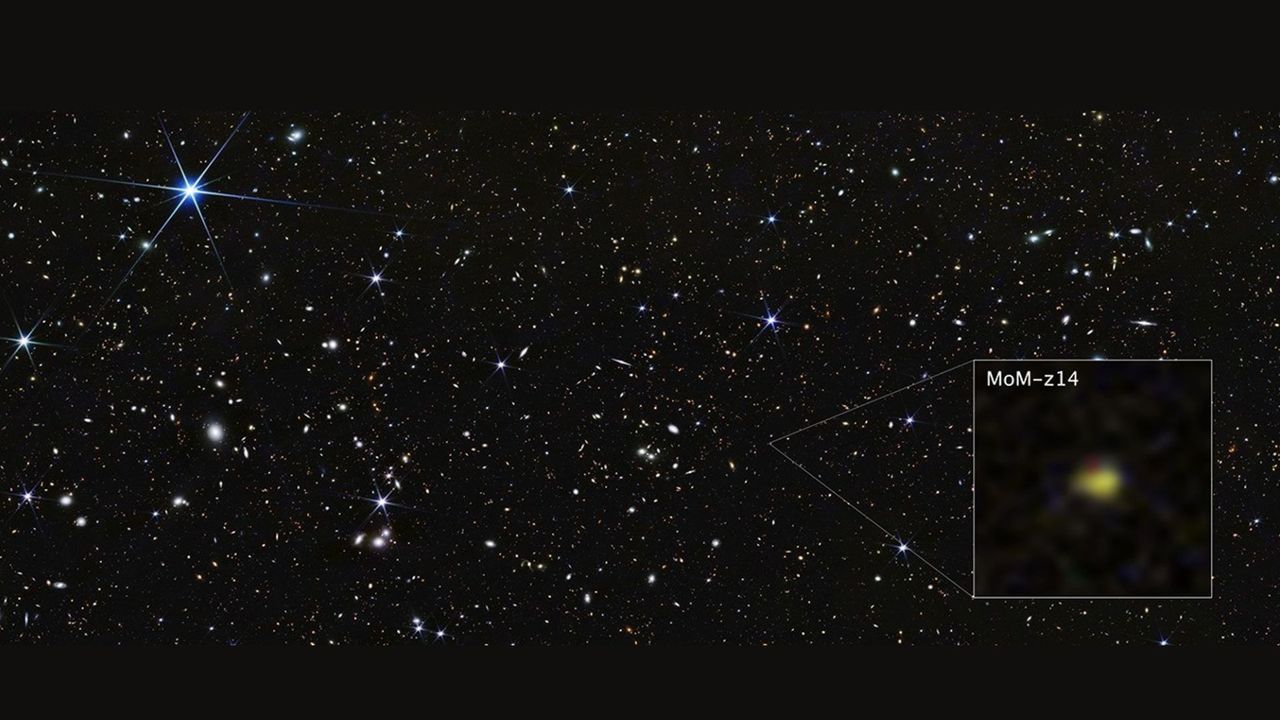
The James Webb Space Telescope (JWST) has identified JADES-GS-z14-0, the most distant galaxy ever detected, with its light originating just 290 million years after the Big Bang. This record-breaking discovery is more than just a measure of distance; the galaxy's unexpected brightness and apparent structure significantly challenge current cosmological models. Astronomers anticipated finding only small, nascent galaxies at this early cosmic epoch. However, JADES-GS-z14-0 appears surprisingly luminous and somewhat organized, suggesting that galaxy formation in the early universe may have been a more rapid and efficient process than predicted by the standard Lambda-CDM model. This finding implies a potential need to revise theories about how the first stars and galaxies formed and evolved. The JWST's advanced infrared capabilities are crucial for these observations, providing unprecedented views into the universe's infancy and prompting a re-evaluation of our understanding of cosmic dawn.